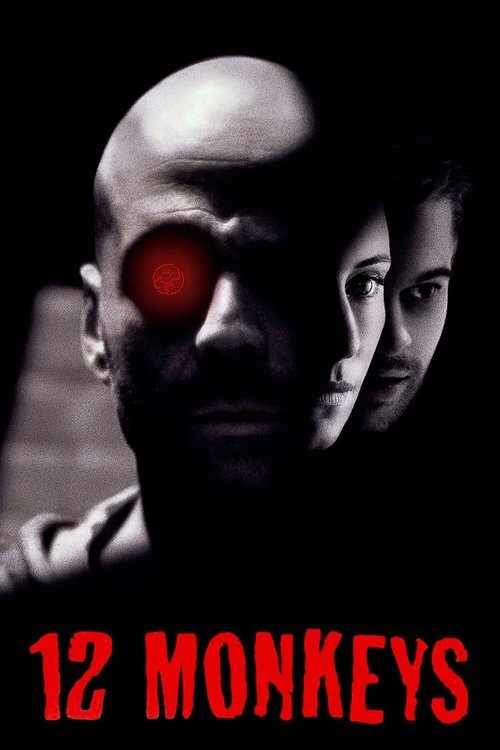
Bruce Willis, Madeleine Stowe, Brad Pitt, Christopher Plummer, David Morse
1995-12-29
In the year 2035, convict James Cole reluctantly volunteers to be sent back in time to discover the origin of a deadly virus that wiped out nearly all of the earth's population and forced the survivors into underground communities. But when Cole is mistakenly sent to 1990 instead of 1996, he's arrested and locked up in a mental hospital. There he meets psychiatrist Dr. Kathryn Railly and the son of a famous virus expert who may hold the key to the Army of the 12 Monkeys; thought to be responsible for unleashing the killer disease.

Terry Gilliam's '12 Monkeys' is a fascinating exploration of time travel and human resilience. The film's non-linear narrative and surreal imagery create a disorienting yet thought-provoking experience. Bruce Willis delivers a compelling performance as James Cole, a man sent back in time to prevent a catastrophic event. The supporting cast, including Brad Pitt and Madeleine Stowe, adds depth to the story. The film's philosophical undertones and examination of fate versus free will resonate deeply. While some may find the film's abstract nature challenging, it rewards viewers with a rich tapestry of ideas and visuals.

A compelling dissection of temporal paradoxes and dystopian futures, '12 Monkeys' delivers a complex narrative that demands a thorough contemplation of its philosophical underpinnings. The film's approach to time travel as a metaphysical quandary rather than a mere plot device is particularly intriguing. Bruce Willis's portrayal of a mentally fractured character navigating a convoluted timeline adds depth to the discourse on fate and free will. The film's aesthetic is both austere and haunting, reflecting the bleakness of its subject matter. While the narrative structure is at times disorienting, it is this very complexity that elevates the film beyond a conventional sci-fi tale.